
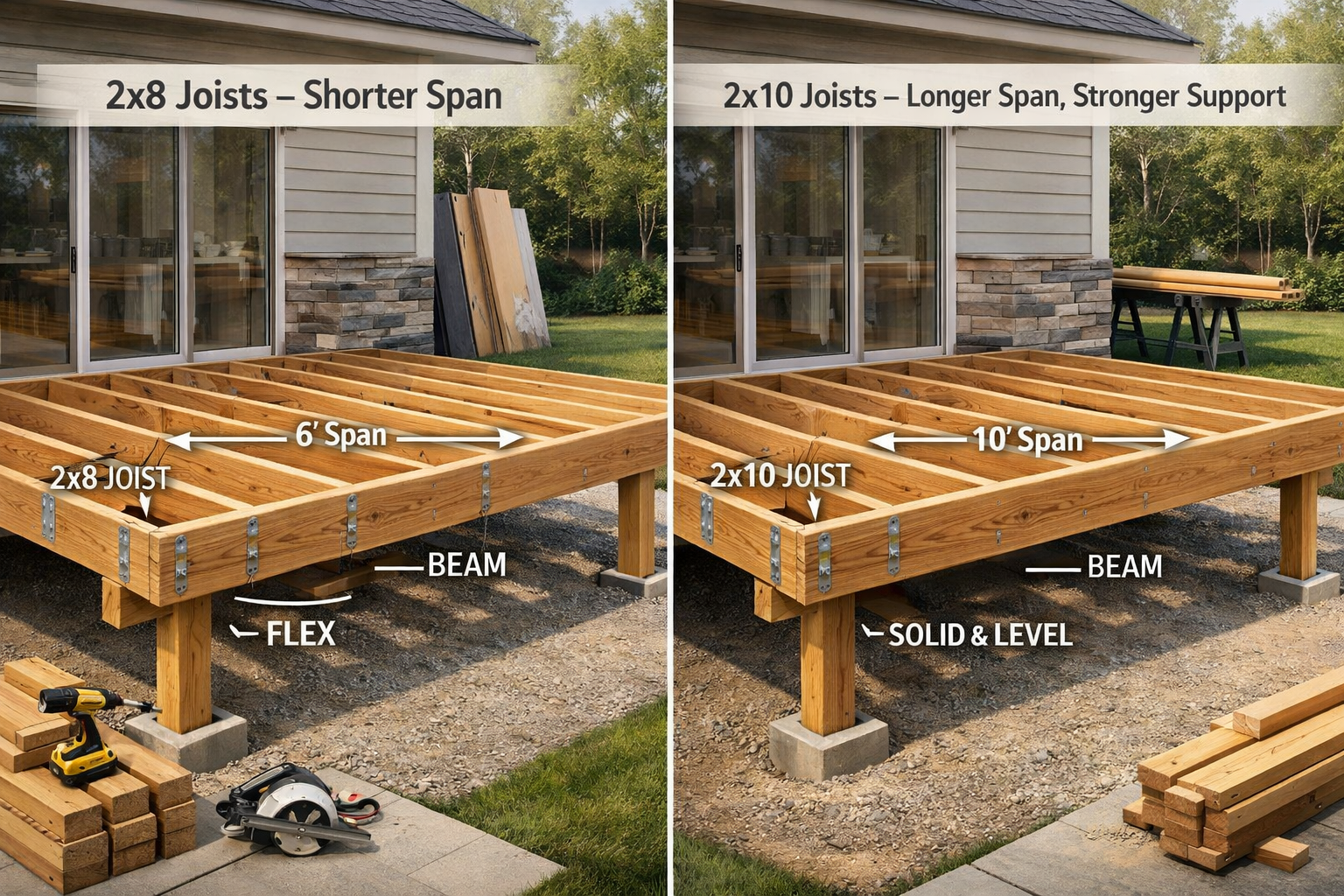
When building or renovating a deck, one of the most important structural decisions you’ll make is choosing the right joist size. Two of the most common options are 2×8 and 2×10 lumber. At first glance, the difference may seem minor, but in reality, joist size plays a major role in your deck’s strength, span capability, stability, and long-term safety.
So how do you know whether you need 2×8 or 2×10 joists for your deck? The answer depends on several key factors, including span length, load requirements, and the type of wood you’re using.
What Are Deck Joists?
Deck joists are the horizontal framing members that run between beams and support the decking boards above. Think of them as the “skeleton” of your deck floor. They distribute weight from people, furniture, and outdoor features down to the beams and posts.
Because joists carry the load of the entire deck surface, choosing the correct size is critical for safety and durability.
Understanding 2×8 vs 2×10 Joists
The numbers “2×8” and “2×10” refer to the nominal size of the lumber:
- 2×8 joists are approximately 1.5 inches thick and 7.25 inches deep
- 2×10 joists are approximately 1.5 inches thick and 9.25 inches deep
The key difference is depth. A deeper joist (2×10) is significantly stronger and can span longer distances without sagging.
Main Difference: Span Capability
The biggest factor in choosing between 2×8 and 2×10 joists is how far they can span between supports.
Typical Span Ranges (depending on wood species and spacing)
- 2×8 joists:
Usually span around 12 to 16 feet - 2×10 joists:
Usually span around 15 to 20+ feet
If your deck design requires fewer support beams or longer open spans, 2×10 joists are usually the better choice.
When 2×8 Joists Are Enough
2×8 joists are commonly used in smaller or lower-load deck projects. They may be the right choice if:
- Your deck span is relatively short
- You have frequent support beams or posts
- The deck is low to the ground
- You’re building a lightweight residential deck
- You want to reduce material costs
2×8 joists can perform very well when properly spaced and supported. However, they are not ideal for large decks or heavy loads.
When You Should Use 2×10 Joists
2×10 joists are stronger and more versatile, making them a better option for many modern deck designs. You should consider 2×10 joists if:
- Your deck has long spans between beams
- You want a more rigid, less “bouncy” surface
- The deck will hold heavy features like hot tubs, outdoor kitchens, or large furniture
- You want fewer support posts underneath
- You are building a raised or elevated deck
In general, 2×10 joists provide better long-term stability and reduce flexing under load.
Load Matters More Than You Think
Decks are designed to handle two types of loads:
- Dead load: the weight of the structure itself
- Live load: people, furniture, grills, snow, etc.
Most residential decks are designed for a live load of about 40 pounds per square foot. However, if you expect heavier use, like gatherings or outdoor installations, upgrading to 2×10 joists is often a smart decision.
Joist Spacing Also Affects Performance
Joist size is only part of the equation. Spacing matters just as much.
Common spacing options include:
- 16 inches on center (OC): most common for residential decks
- 12 inches OC: used for heavier loads or composite decking
- 24 inches OC: only for specific engineered applications
If you choose 2×8 joists, tighter spacing may be required to maintain strength. With 2×10 joists, you often get more flexibility.
Wood Type Matters Too
Not all lumber performs the same. Strength varies depending on species:
- Pressure-treated pine (most common)
- Cedar (naturally resistant but slightly weaker)
- Douglas fir (stronger and widely used for framing)
A stronger wood species may allow slightly longer spans even with 2×8 joists, but 2×10 still offers a clear advantage in most cases.
Cost vs Performance
Naturally, 2×10 joists cost more than 2×8 joists. However, the difference is often worth it when you consider:
- Increased safety
- Reduced bounce and vibration
- Longer lifespan of the structure
- Fewer support posts needed
- Better resale value of your home
In many cases, choosing 2×10 joists can actually reduce overall construction complexity, even if the lumber itself is more expensive.
Common Mistakes Homeowners Make
Here are a few mistakes to avoid when choosing joists:
1. Choosing based only on cost
Saving money upfront can lead to sagging or structural issues later.
2. Ignoring span tables
Always refer to building code span charts or consult a professional.
3. Underestimating future use
A deck might start simple but later hold heavy furniture or upgrades.
4. Improper spacing
Even strong joists will fail if spaced incorrectly.
So, Which One Should You Choose?
Here’s a simple way to decide:
- Choose 2×8 joists if your deck is small, low, and heavily supported
- Choose 2×10 joists if you want strength, longer spans, and future flexibility
When in doubt, 2×10 joists are generally the safer and more durable choice.
Final Thoughts
Selecting between 2×8 and 2×10 joists isn’t just a technical detail it’s a decision that directly affects the safety, comfort, and lifespan of your deck. While 2×8 joists can work for smaller, simpler builds, 2×10 joists offer greater strength, reduced flex, and more design flexibility.
FAQs
How do I know if 2×8 joists are strong enough for my deck?
2×8 joists are usually enough for smaller decks with shorter spans and proper beam support. If your deck is low to the ground and doesn’t have heavy loads like hot tubs or outdoor kitchens, 2x8s may work fine. Always check span tables for your specific wood type and spacing.
Are 2×10 joists always better than 2×8 joists?
Not always, but they are stronger and allow longer spans with less flex. 2×10 joists are better for larger decks, heavier loads, or designs with fewer support posts. For small, simple decks, 2×8 joists can still be perfectly sufficient.
What happens if I use the wrong joist size?
Using undersized joists can cause the deck to feel bouncy, sag over time, or even become unsafe under heavy loads. That’s why it’s important to follow building codes or consult a professional before finalizing your design.
Can I reduce cost by using 2×8 joists instead of 2×10?
Yes, 2×8 joists are cheaper, but savings may come at the cost of strength and durability. If your design requires more support posts to compensate, the cost difference may be smaller than expected.
Do joist spacing and size work together?
Yes, they are closely connected. 2×8 joists often require tighter spacing (like 12–16 inches on center), while 2×10 joists can sometimes allow more flexibility depending on load and decking material.